Have you ever worried about how a sudden medical need might drain your life savings?
Nationwide Final Expense has guided Central Texas seniors through this exact concern for over 63 years. Our licensed advisors help families across Austin, Round Rock, and the surrounding counties set up irrevocable funeral trusts that shield burial funds from Medicaid spend-down.
Texas Medicaid limits countable assets for an individual to just $2,000. That strict threshold often stands between seniors and the long-term care they need. We help you protect your final arrangements without violating those rules.
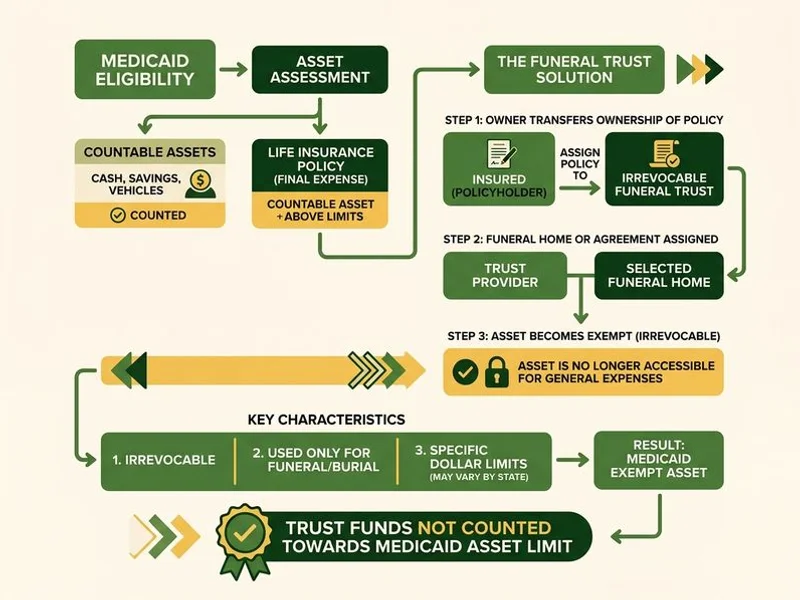
Irrevocable funeral trusts are legally binding agreements used throughout Central Texas asset planning. Properly structured, these trusts hold a final expense policy and convert the cash value into an exempt asset under Texas Health and Human Services Commission (HHSC) regulations.
Below, we explain exactly how this strategy keeps your countable assets under the limit while your burial expenses stay fully covered.
This approach is worth considering if you anticipate Medicaid being part of your future care plan. Read on to learn how to secure your burial expenses without relying on family contributions or county aid.

Why the Texas $2,000 Medicaid asset limit matters
Texas Medicaid evaluates countable assets when determining eligibility. These assets include bank accounts, brokerage holdings, and the cash surrender value of certain insurance policies. The cost of care drains these accounts fast. In 2026, the average cost of a semi-private room in a Texas nursing home exceeds $6,500 per month.
If you exceed the $2,000 limit, the state requires you to spend down your money to qualify for aid. Setting aside funeral costs in advance through a trust reduces your countable assets. Financial planners and elder-law attorneys across Travis, Williamson, and Hays Counties regularly use this strategy to fund exact burial costs. An irrevocable funeral trust serves as the legal vehicle that holds that earmarked money.
The irrevocable nature of the trust is the key feature. Because you cannot pull the funds back, HHSC stops counting them against your Medicaid asset limit. Giving up control sounds difficult at first, but the trade-off is straightforward: you surrender access to the cash value, and the state grants you the asset exemption in return.
Countable vs. Exempt Assets
| Asset Type | Medicaid Status |
|---|---|
| Checking and Savings Accounts | Countable (Subject to $2,000 limit) |
| Standard Life Insurance Cash Value | Countable |
| Irrevocable Funeral Trust Funds | Exempt |
How a funeral trust pairs with final expense coverage
This trust does not replace your underlying guaranteed acceptance burial insurance - it serves as a protective container for it. Nationwide Final Expense guides families through a straightforward flow. A Funeral Advantage whole life policy is purchased first. The legal document is then drafted under Texas Health and Safety Code Chapter 697.
Chapter 697 governs prepaid funeral benefits across the state. A Texas-licensed elder-law or estate-planning attorney handles the legal drafting. Ownership of the policy then transfers directly to the trust.
At the time of need, the death benefit pays out for funeral expenses through the trust. Your family still receives the 24-hour claim payout that a Funeral Advantage policy provides. The order of operations matters here - sequencing the policy purchase and the trust setup correctly prevents a paperwork disaster.
The Correct Setup Sequence
- Calculate your target coverage: The average traditional funeral in Texas costs around $8,700 in 2026, while direct cremation averages $1,995.
- Purchase the policy: Secure a final expense life insurance plan to fund the exact amount you need.
- Draft the legal trust: Have a qualified attorney prepare the document under Chapter 697.
- Transfer ownership: Assign the policy directly to the irrevocable trust to complete the exemption process.
When does this Medicaid strategy make sense?
This combination works best if you or a parent are planning for the possibility of needing nursing home care covered by Texas Medicaid. Recent data shows that roughly 70% of adults turning 65 will require some form of long-term care during their lifetime. About 20% of those individuals will need care for more than five years.
You want your burial expenses covered in advance so your family does not have to scramble for funds. You must also be willing to give up access to the money in the policy.
The defining rule of an exempt asset is simple: you must surrender control of the funds to secure your Medicaid qualification and protect your family’s financial future.
How Nationwide Final Expense Compares
| Feature | Typical Provider | Nationwide Final Expense |
|---|---|---|
| Trust coordination | Client arranges attorney separately | Coordinated policy and attorney referral in correct sequence |
| Claim payout speed | Industry average: weeks to months | 24 hours after claim approval |
| Family support at time of need | No dedicated guidance | FCGS membership included - a dedicated representative handles funeral arrangements |
| Medical exam | Often required | No medical exam for Funeral Advantage policies |
This strategy does not make sense for everyone. If you do not expect Medicaid to be part of your situation, a standalone final expense policy is usually enough.
If you want to talk through whether this combination fits your life, call (800) 930-7459. Our licensed advisors explain how the sequencing works and can refer you to a Texas-licensed attorney for the trust paperwork. There is no obligation, and the call is free.
Serving seniors across Central Texas
Nationwide Final Expense helps seniors and their adult children plan asset protection throughout the region, including Austin, Round Rock, Georgetown, Pflugerville, and Hutto. For families coordinating Medicaid eligibility with county programs, we also explain how Travis County burial assistance, Williamson County burial assistance, and Hays County burial assistance interact with a funeral trust.