
concern
Pros and Cons of Prepaying an Austin Funeral Home
Prepaying a funeral home has real upsides and real risks: portability, refunds, what happens if the home closes or you move. See both sides honestly.
Updated June 25, 2026 · 6 min read

A balanced look at prepaying funeral home pros and cons
We often hear from seniors on fixed incomes who are torn about the decision and want to understand prepaying funeral home pros and cons. This choice feels heavy because there is conflicting advice about securing your final arrangements.
It remains one of the most polarizing decisions in funeral planning today. Our team at Nationwide Final Expense was founded with a simple mission: to provide exceptional final expense life insurance services that customers can truly rely on.
From that practical background, you will see that prepaying has real upsides and significant risks depending on your budget. We will break down exactly what you need to know, including:
- Texas state protections for your money.
- Hidden cancellation fees that trap families.
- The true cost of funeral inflation in Austin.
For a deeper comparison of preneed against insurance, see the parent page on Preneed vs. Final Expense Funding.
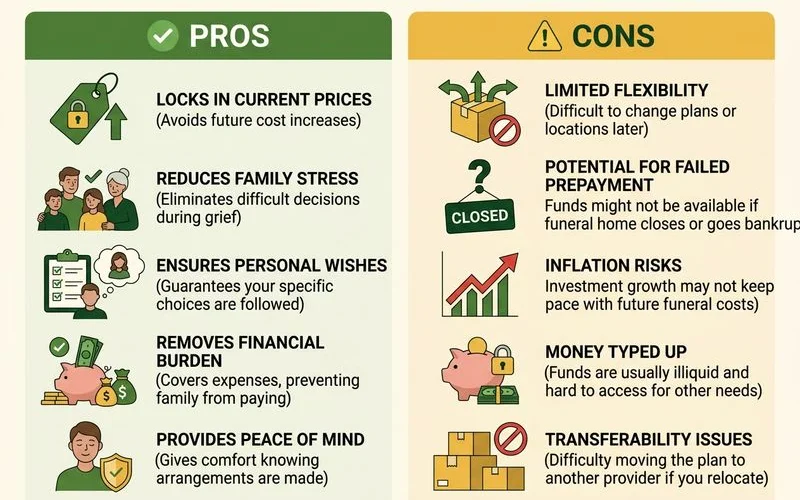
The pros
Locking in costs offers massive financial relief for many families. A prearranged plan protects your loved ones from the shock of unexpected end-of-life expenses by securing today’s prices.
The National Funeral Directors Association notes that funeral costs rise by an average of 3.4% to 5% annually. Our team sees how an $8,700 average traditional burial in Austin today can easily cost thousands more in ten years. These rising costs make long-term price protection highly valuable if you live 15 to 20 more years. Let’s review the main advantages of prepaying a funeral home.
- Price lock on specific items: The casket, the concrete vault, and the basic services fee are secured at today’s rates.
- Total decision control: Every detail is planned and paid for in advance, so your grieving family has no stressful choices to make.
- Texas regulatory protection: The Texas Department of Banking audits these funds under Chapter 154 of the Texas Finance Code.
- Guaranty fund safety net: If your chosen provider defaults, the state’s Prepaid Funeral Guaranty Fund ensures another seller fulfills the contract at no extra cost.
We always remind families that prepaying forces a difficult but necessary conversation. Sitting down with a director prompts you to document your exact wishes in writing.
For the definition and regulatory background, see what is a preneed funeral contract.
The cons
We must warn you that extreme inflexibility is the biggest drawback of a preneed contract. Tying your money to one specific funeral home can backfire if your life circumstances change.
Consumer finance experts like Dave Ramsey and Clark Howard frequently advise against these plans because the preneed funeral plan risks involve funds that are notoriously difficult to transfer. Our clients often do not realize that moving out of the Austin area creates massive preneed contract problems. Texas regulations allow you to transfer or cancel, but doing so usually triggers administrative fees or penalties. Here are the most common pitfalls you need to avoid.
- Tied to one location: If your preferred home closes, changes ownership, or you move out of state, transferring the plan is difficult and often incurs fees.
- Partial refund risks: Trust-funded contract cancellations refund the balance minus administrative fees. Insurance-funded cancellations are based on the cash surrender value, which is usually lower than your paid premiums in the early years.
- Inflation on excluded items: The contract only locks in the specific merchandise you selected. If your family adds a different casket, an extra service, or an out-of-town transport, those additions are billed at future retail rates.
- Zero cash flexibility: Outstanding medical bills, a cemetery plot, a headstone, or small legacy gifts are not covered. Cash is completely unavailable for these non-funeral costs, leaving the burden on your family.
We strongly agree with consumer advocates who emphasize the importance of portability. A pre-arranged plan cannot easily adapt if your family suddenly prefers cremation over burial years later.
The portability question matters most
If there is any chance you might move to a different state or city in the next 10 to 20 years, the preneed contract starts to look weaker. Cash benefits from final expense insurance travel with you. Tied funeral plans largely do not.
Who should prepay (and who probably shouldn’t)
We recommend prepaying only if you plan to stay in Central Texas permanently and want absolute certainty over a specific service. Most individuals on fixed incomes should probably skip it to maintain financial flexibility for their families.
If you are asking, “should i prepay my funeral?” compare the situations below to see where you fit best. Our comparison table breaks down the clear differences between committing to a funeral home versus maintaining your independence.
| Your Situation | The Best Approach | The Reason Why |
|---|---|---|
| You will never leave Austin and want specific services locked in. | Prepay the Funeral Home | Provides maximum price protection on exact items. |
| You might relocate or want cash left for medical bills and headstones. | Skip the Preneed Contract | Protects your family from cancellation fees and locked funds. |
| You want a specific casket but also need funds for a cemetery plot. | Consider Using Both | Combines a small tied contract with a flexible cash policy. |
Many Central Texas families successfully use a hybrid strategy. They secure a small preneed contract for the basic burial service, then purchase a final expense policy to cover everything else around it. This combination gives you the best of both worlds without locking up all your available cash.
Our team is always here to help you evaluate your specific budget without any pressure. If you want to talk through whether prepaying fits your situation, call (800) 930-7459.
We do not sell preneed contracts, which means our comparison is honest, giving you the power to make the call after reviewing these prepaying funeral home pros and cons. Protecting your family is the primary goal, so take the time to choose the path that offers the most peace of mind.
Frequently Asked Questions
What happens if the funeral home goes out of business?
Can I get my money back if I change my mind?
Is the price really locked in?
Learn more about Preneed vs. Final Expense Funding
Plain-English help deciding between locking in prices with a funeral home and keeping flexible cash with final expense insurance.
Explore Preneed vs. Final ExpenseRelated Guides
Preneed Funeral Contract vs. Final Expense Insurance
Preneed locks prices with one funeral home; final expense pays flexible cash to your family. Compare cost, control, and who each option suits best.
What Is a Preneed Funeral Contract?
A preneed funeral contract lets you prepay and lock in prices with a funeral home. How it works in Texas, what's locked in, and the oversight that protects you.